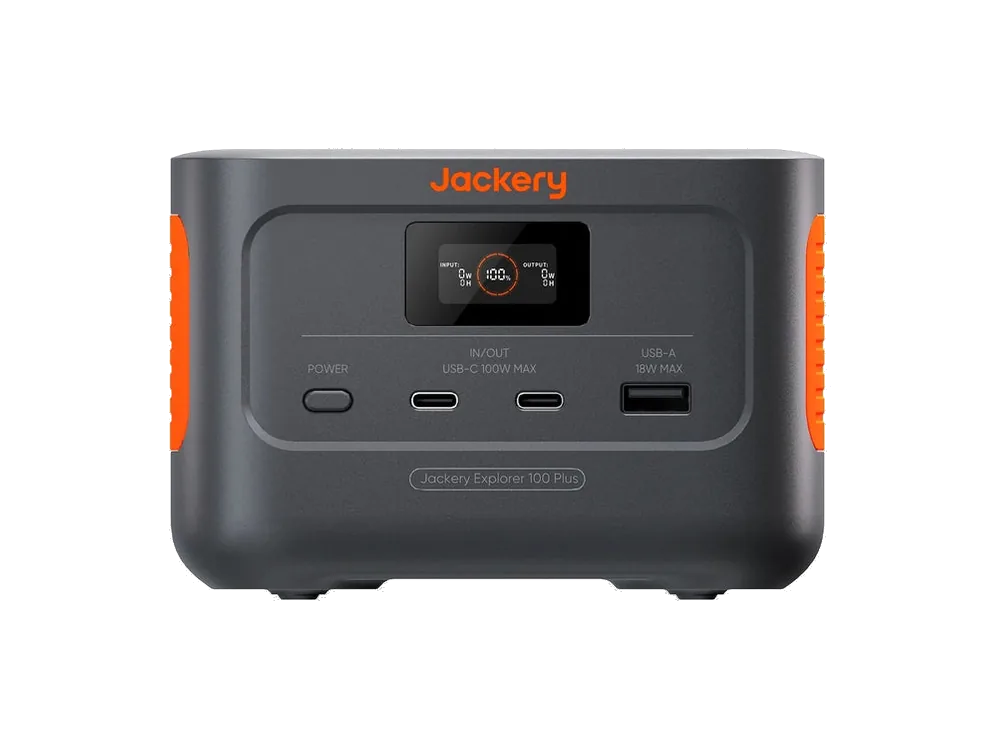
Jackery
Explorer 100 Plus
99 Wh battery, output not confirmed yet. Small: CPAP, laptops, lights and phones. A 40 W CPAP runs about 2 hours.
Battery
99 Wh
fridge about 1.5 hours
Output
n/a
surge not confirmed yet
Solar in
100 W
full in about 1.5 hours
Weight
2.1 lb
one hand
Where to buyPrices checked Oct 27, 2026
Jackery store
Out of stock at the Jackery store when we checked
We may earn a commission if you buy through these links. It never changes a verdict.
What can it run, and for how long?
Tap what you would plug in. Hours assume a full battery and 15% lost to conversion.
Fridge + LED lights + Phone
1 hours
on a full charge, drawing 80 WBattery over time80 W draw
Full1 hours
Together these draw 80 W. This station puts out n/a W. It will shut off. Remove the biggest item or run them one at a time.
Specs in plain English
Tap any underlined term for a one-sentence explanation.
Wh
99 WhFrom the manual
Enough for a 60 W fridge for about 1.5 hours, or a CPAP for about 2 hours.Wh Watt-hours. Battery size. How much energy is stored. 1,000 Wh runs a 100W device for about 8.5 hours after losses.
W
Not confirmed yet
W Watts. Power right now. The station has a maximum it can put out; each appliance has a draw.
Surge
Not confirmed yet
Surge A short burst of extra output the station can deliver for a second or two, for motors starting.
Voc
18 to 27.2 VFrom the manual
The manual does not say whether this is open-circuit or working voltage, so the checker uses the stricter reading. Your panels, wired up, must stay inside it even on a cold morning.Voc Open-circuit voltage. The highest voltage a panel makes, with nothing connected. Rises in cold.
Imp
5 AFrom the manual
Over this, the station simply caps what it takes. You lose watts, nothing breaks.Imp Current at maximum power. The working current when the panel is actually charging.
MPPT
100 WFrom the manual
From empty to full in about 1.5 hours of good sun at 70% of rating.MPPT Maximum power point tracker. The charge controller inside the station that finds the best voltage to pull from the panels.
Solar portplug
USB-CFrom the manual
The plug on the station. Panels with a different plug need an adapter cable; we list it in the checker.LiFePO4
LiFePO4From the manual
Long-life chemistry, suited to daily solar use. Check the manual for the exact cycle rating.LiFePO4 Lithium iron phosphate. The battery chemistry in most current stations. Rated for thousands of full cycles; check the manual for the exact number.
Weightlb
2.1 lbFrom the manual
One-hand carry.Solar panels that work with it
Checked against the 18 to 27.2 V input range and the 5 A current cap, on a 20F morning. Change panels, count and temperature in the full checker.
Jackery
SolarSaga 200 (JS-200E)
1 panelWorks
2 panels, in parallelWorks
Jackery
SolarSaga 200 (JS-200D)
1 panelWorks
2 panels, in parallelWorks
EcoFlow
400W Portable Solar Panel
1 panelDon't connect
2 panels, in parallelDon't connect
EcoFlow
NextGen 220W Bifacial Portable Solar Panel
1 panelWorks
2 panels, in parallelWorks
BLUETTI
PV200D
1 panelWorks
2 panels, in parallelWorks
BLUETTI
PV350D
1 panelDon't connect
2 panels, in parallelDon't connect
Anker SOLIX
PS100 Bifacial
1 panelWorks, with a catch
2 panels, in parallelWorks, with a catch
Anker SOLIX
PS200 Bifacial
1 panelDon't connect
2 panels, in parallelDon't connect
Watch out for
Things in the manual that catch new owners.
01Solar charging goes in through the USB-C port (18 to 27.2V, 100W max).
Having a problem?
Short fixes from the manuals.
Sources
From the manualJackery Explorer 100 Plus user manual
Also checked:jackery.com
Shop listing, not yet confirmedPrice, from the Jackery store on Oct 27, 2026 (checked every morning)
Spotted an error? Email [email protected] with the manual page number.